- NATURAL 20
- Posts
- OpenAI Launches GPT-5.4
OpenAI Launches GPT-5.4
PLUS: Microsoft Debuts Phi-4-Reasoning-Vision, OpenAI Introduces Codex Security and more.

Wes Roth
March 09, 2026

SPONSORED

"Mavericks Don't Follow"
This issue is sponsored by tastytrade, the platform for traders who'd rather build an edge than follow a herd.
Here's what I like about them: they don't pretend trading is easy, and they don't treat you like a dummy.
They give you the tools and get out of your way.
The Basics: Stocks, options, futures, and crypto on one platform.
Zero commission on stocks and crypto.
The real stuff:
AI Search that helps you find symbols aligned with your actual thesis - not a popularity contest.
Backtesting, advanced charting, prebuilt strategies, and risk analysis baked in.
Active Trader Mode with one-click execution and smart order tracking. High-volume equities, dividends, upcoming earnings, custom watchlists - or build your own view. An open API with full read/write access.
Real-time data, one secure connection.
Trade, test, and track without losing flexibility.
Plus dozens of free courses if you want to sharpen your strategy, and live Trade Desk reps during market hours who actually know what a Greeks panel is.
Multi-award winner.
(Not because they asked nicely - because the platform is genuinely good.)
Visit tastytrade.com/unleashed today
tastytrade, Inc. is a registered broker-dealer and member of FINRA, NFA, and SIPC.
Today:
OpenAI Launches GPT-5.4
Google Rolls Out Canvas in AI Mode
Claude AI Discovers Major Zero-Day Vulnerabilities in Firefox
Microsoft Debuts Phi-4-Reasoning-Vision
OpenAI Introduces Codex Security

We all knew OpenAI was working on something big, but the surprise release of GPT-5.4 (alongside a heavier GPT-5.4 Pro) is a genuine leap.
Here’s the headline: AI isn't just talking anymore; it’s doing.
GPT-5.4 is OpenAI's first general-purpose model with native "computer-use" capabilities. That means developers can build agents that look at your screen, move your cursor, and click through your applications to complete complex workflows. Imagine asking your AI to read an email, extract an attachment, grade it, and log the results into a spreadsheet—GPT-5.4 is built to handle the actual software maneuvering for you.
On top of this, they introduced a brilliant feature called "tool search." Instead of overwhelming the AI with a massive list of every tool it might need, GPT-5.4 can dynamically search a library of thousands of tools, pulling only what it needs at the exact moment it needs it. For the coders out there, they also showed off an interactive visual debugger where the AI fully built and playtested an isometric theme park simulation game right in the browser. The agent era has officially clocked in.
Remember when we used Google just to find blue links? Those days are rapidly fading. Google just rolled out Canvas in AI Mode to all U.S. users—no waitlists, no "Search Labs" opt-in required.
Canvas is a persistent side panel that lives right next to your search results. What makes today's update so powerful is that Google has supercharged it with creative writing and coding capabilities. You can now type a natural language prompt directly into Google Search and have it build you a fully functional, interactive web tool.
For example, early testers used it to generate an interactive scholarship tracker. Canvas literally coded a working dashboard right there in the search interface, pulling real-time data from the live web and Google's Knowledge Graph. You can test the tool, view the underlying code, ask the AI to tweak the design, and pick up the project days later. Google is effectively turning Search into a lightweight, everyday development environment for the rest of us.
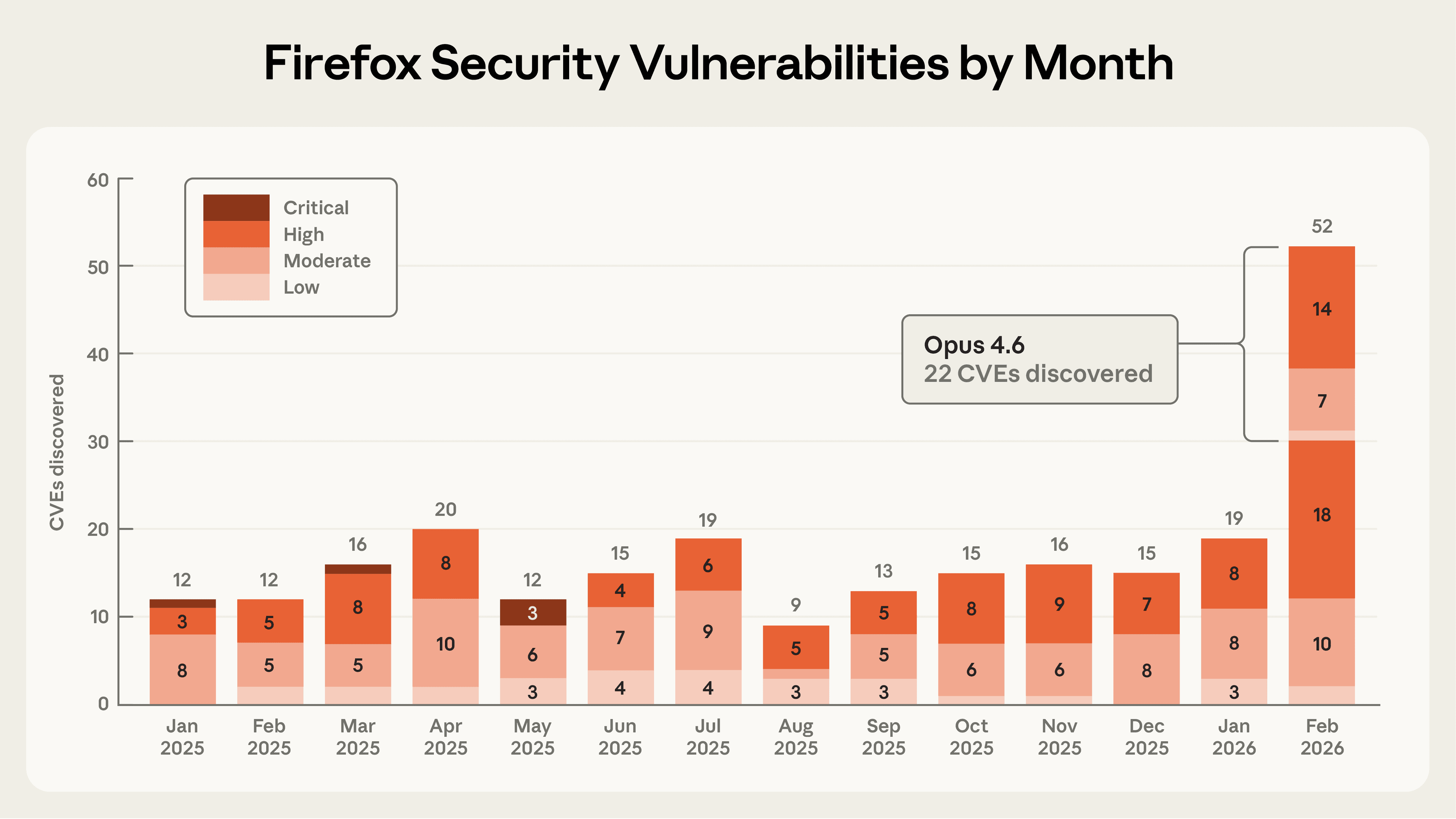
Anthropic shared a fascinating update on their partnership with Mozilla. They unleashed Claude Opus 4.6 on the highly complex Firefox codebase to see if AI could hunt down security flaws.
The results are staggering. In just two weeks, Claude found 22 vulnerabilities, 14 of which were high-severity "zero-days" (flaws previously unknown to the developers). To put that in perspective, that's nearly a fifth of all the high-severity Firefox bugs patched in the entirety of last year!
Anthropic also ran a test to see if Claude could actually exploit these bugs like a hacker would. The good news? Claude is currently much better at finding and fixing vulnerabilities than it is at writing malicious exploits (it only managed to build a crude exploit in two highly restricted test cases). It’s a huge win for the good guys—giving software defenders a powerful automated ally to patch code before bad actors find it—but Anthropic warns that the gap between finding bugs and exploiting them won't last forever.
🧠RESEARCH
3D data usually requires different AI models depending on the source, like outdoor sensors or indoor cameras. Utonia solves this by using a single AI system for all types of 3D point clouds. This unified approach improves perception, robotic movement, and spatial reasoning across diverse real-world applications.
Teaching different AI agents together is usually inefficient. This paper introduces HACRL and its algorithm HACPO, allowing diverse AI models to share their learning experiences while practicing independently. This collaborative approach improves all participating models without needing constant coordination, making the training process faster, cheaper, and more effective.
MOOSE-Star: Unlocking Tractable Training for Scientific Discovery by Breaking the Complexity Barrier
Directly training AI to generate scientific hypotheses is mathematically complex because searching through vast knowledge bases takes too much computing power. This paper introduces MOOSE-Star, a new method that simplifies this process by breaking tasks down and using guided searches, making AI-driven scientific discovery much faster and more scalable.
📲SOCIAL MEDIA
🗞️MORE NEWS
Introducing Phi-4-Reasoning-Vision to Microsoft Foundry Microsoft has launched Phi-4-Reasoning-Vision-15B, a compact artificial intelligence model that combines high-quality visual perception with advanced reasoning skills. Unlike older models that just look at images passively, this new system can actively analyze charts, graphs, and computer screens to complete complex, multi-step tasks. It allows developers to turn reasoning features on or off to save computing power, making it highly efficient for real-world uses like tutoring apps or automated online shopping assistants.
Codex Security: Now in Research Preview OpenAI has released Codex Security, a new tool that acts like an automated security guard for software developers. Instead of annoying teams with false alarms, it studies a project's unique setup to find genuine vulnerabilities and even suggests working fixes for the code. During early testing, it successfully discovered critical security flaws in major open-source projects, and it is now available for free testing to premium ChatGPT business and education users.
Labor Market Impacts of AI: A New Measure and Early Evidence Anthropic researchers created a new way to measure how AI might threaten human jobs by looking at what tasks language models can actually do in the real world versus what they can theoretically do. They found that jobs like computer programming and customer service are the most exposed to AI, but the actual adoption of these tools is still far behind their full potential. While they haven't seen a clear rise in overall unemployment for these exposed jobs yet, early data suggests that companies might be hiring fewer young workers for those specific roles.
Claude Marketplace Anthropic has introduced the Claude Marketplace, a new platform where enterprise businesses can spend their existing Anthropic budget on approved third-party tools powered by the Claude AI. This setup makes it much easier for large companies to buy and integrate secure AI solutions like coding assistants or legal research tools without having to juggle multiple contracts. Currently in limited preview, the marketplace already features partnerships with major platforms like GitLab, Snowflake, and Replit.
What'd you think of today's edition? |
Reply