- NATURAL 20
- Posts
- xAI Secures a Massive $20 Billion War Chest
xAI Secures a Massive $20 Billion War Chest
PLUS: Universal Music and Nvidia Partner to Protect Artists, Top AI Models Are Now Deadlocked in Performance and more.

Wes Roth
January 07, 2026
In partnership with


The Future of Shopping? AI + Actual Humans.

AI has changed how consumers shop by speeding up research. But one thing hasn’t changed: shoppers still trust people more than AI.
Levanta’s new Affiliate 3.0 Consumer Report reveals a major shift in how shoppers blend AI tools with human influence. Consumers use AI to explore options, but when it comes time to buy, they still turn to creators, communities, and real experiences to validate their decisions.
The data shows:
Only 10% of shoppers buy through AI-recommended links
87% discover products through creators, blogs, or communities they trust
Human sources like reviews and creators rank higher in trust than AI recommendations
The most effective brands are combining AI discovery with authentic human influence to drive measurable conversions.
Affiliate marketing isn’t being replaced by AI, it’s being amplified by it.
Happy Wednesday!
Just when you think things might settle down for a post-holiday breather, the industry collectively says, "Hold my GPU."
We have some massive updates to get through today—from eye-watering funding rounds to models that run right on your phone. Let’s dive in.
Today:
xAI Secures a Massive $20 Billion War Chest
Liquid AI Brings Powerful Intelligence to Your Pocket
AMD Unveils the Chips Powering the Next Era of AI
Universal Music and Nvidia Partner to Protect Artists
Top AI Models Are Now Deadlocked in Performance
xAI announced it closed an upsized Series E for $20 billion (above a $15B target), with a mix of financial and strategic backers including NVIDIA and Cisco Investments called out as strategic investors.
The part that matters isn’t the headline number. It’s what they say the money is for: scaling compute fast. They frame it around expanding “Colossus I and II” and claim they ended 2025 with “over one million H100 GPU equivalents.” They also tease that Grok 5 is currently in training and that the funding accelerates both infrastructure and product rollout.
My read: we’re going to see more “model capability = who can feed the beast” dynamics in 2026. If you’re building, this kind of capital usually shows up later as cheaper inference, faster voice, better multimodal, and more enterprise hooks because the whole point is utilization.
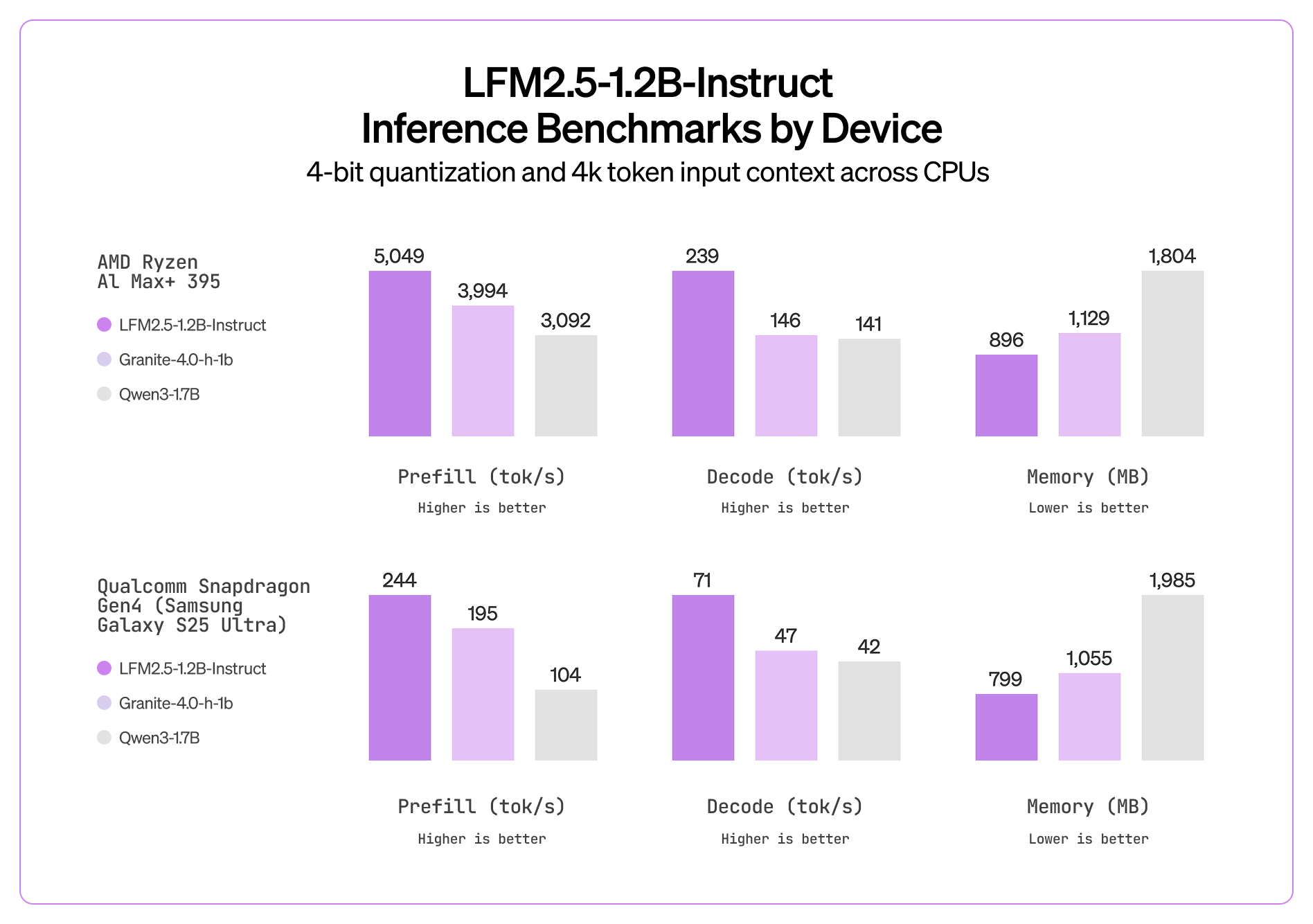
Liquid AI introduced LFM2.5-1.2B, positioned as their most capable “edge/on-device” release so far. The detail that jumped out: they say they extended pretraining from 10T to 28T tokens, and scaled up post-training with reinforcement learning (basically: training the model through many rounds of feedback so it follows instructions better).
This is a full family drop — Base, Instruct, Japanese, plus Vision-Language (understands images + text) and Audio-Language (speech). They also claim the new audio model is 8× faster than the previous one and is meant to run on constrained hardware like vehicles, phones, and IoT devices.
And here’s the practical kicker: they say the models are open-weight and available now (they mention distribution via Hugging Face / their platform), with AMD and Nexa AI as launch partners optimizing performance on NPUs (the “AI accelerator” inside newer chips).
Why I think this matters: the best on-device models aren’t just about being “offline.” They’re about latency (instant), privacy (your data stays local), reliability (works even when the cloud doesn’t), and cost (no per-call bill shock). If 2025 was “agents everywhere,” 2026 is starting to look like “agents everywhere… including in your pocket.”
AMD’s CES 2026 message is basically: we’re building the full stack, from racks to laptops to embedded chips.
Highlights from their press release:
Early look at “Helios”, a rack-scale platform “blueprint” built on Instinct MI455X GPUs and EPYC “Venice” CPUs, aimed at ultra-large AI infrastructure.
A new Instinct MI440X GPU for enterprise/on-prem deployments, plus a preview of the next-gen MI500 Series (they say planned for 2027) and make an aggressive performance claim versus MI300X.
New Ryzen AI 400 / Ryzen AI PRO 400 platforms with a 60 TOPS NPU (translation: a stronger on-laptop AI engine), with first systems shipping January 2026 and broader OEM availability in Q1 2026.
They also mention expanding embedded Ryzen AI for edge use cases (including things like robotics/autonomous systems) and a $150M commitment tied to AI education access.
If you zoom out, AMD is trying to make one story out of everything: big GPUs for training, PC chips for local inference, and embedded parts for the physical world. It’s the same two-lane future just under one brand umbrella.
🧠RESEARCH
NextFlow is a new "all-in-one" AI that handles text and images together. By generating pictures in layers rather than pixel-by-pixel, it creates high-quality images in seconds. This unified approach allows it to edit images and understand complex requests better than systems that keep text and visuals separate.
DreamID-V is a new tool for swapping faces in videos with incredible realism. It solves the "jittery" look of older deepfakes by using advanced diffusion technology to match lighting and expressions perfectly. The result is a system that keeps the identity consistent across every frame of a video.
Researchers found that training AI solely to get the "right" answer hurts its creativity. This "diversity collapse" makes models predictable and repetitive. To fix this, they developed a new teaching method called DCR, which rewards AI for finding unique, diverse solutions to problems instead of just following a script.
🛠️TOP TOOLS
Each listing includes a hands-on tutorial so you can get started right away, whether you’re a beginner or a pro.
Blush AI – AI-Powered Dating Simulator - mobile AI dating simulator that lets you practice flirting and communication with lifelike “crush” characters in a private, judgment‑free space.
Bodt – AI-Powered Conversational Chatbot for Websites - no‑code conversational AI platform that lets you build and embed a ChatGPT‑powered bot trained on your own website and files.
Boo AI -AI-Powered Writing Assistant - minimalist text editor with built‑in AI that helps you draft, extend, and refine writing.
📲SOCIAL MEDIA
🗞️MORE NEWS
Universal Music & Nvidia AI Deal Universal Music Group and Nvidia are launching "Music Flamingo," a new AI tool that understands the melody and lyrics of songs to help fans find music they love. The partnership also includes an "artist incubator" where musicians will help build AI tools that assist creativity rather than replacing it. This collaboration aims to fix the problem of generic AI content by ensuring human artists stay at the center of the music-making process.
AI Benchmark Tie A new industry test shows that the top AI models from Google, OpenAI, and Anthropic are now effectively tied in performance. The "Intelligence Index" ranks GPT-5.2, Claude Opus 4.5, and Gemini 3 Pro within a single point of each other, proving that no single company currently has a significant lead. This deadlock suggests the "arms race" for smarter AI is tightening, with all three tech giants releasing equally powerful tools at the same time.
Intel Handheld Gaming Platform Intel is building its own portable gaming device to challenge the dominance of the Steam Deck and other handheld PCs. The new system will run on Intel’s upcoming "Panther Lake" chips, which promise longer battery life and faster graphics performance than current rivals. By creating both the hardware and the software, Intel hopes to offer a smoother experience for gamers who want to play PC games on the go.
Nvidia’s Manufacturing Struggles Despite its massive success in selling AI chips, Nvidia is struggling to get manufacturers to adopt its "Omniverse" software, which creates digital replicas of factories to test efficiency. Clients are slow to buy the new software because it is expensive and difficult to integrate into their existing systems. This report highlights the challenge Nvidia faces in expanding its business beyond hardware and into the slow-moving world of industrial operations.
AI Spots "Hidden" Cancer A new AI tool called PANDA can detect pancreatic cancer in standard CT scans that human doctors often miss. It has already been granted "breakthrough" status by the FDA for its ability to spot tumors early, potentially saving lives. However, doctors caution that it currently triggers too many false alarms, which could lead to unnecessary stress and testing.
ChatGPT Struggles to Make Money Despite having 900 million weekly users, only 5% of people actually pay for a ChatGPT subscription. Most users are outside the U.S., where ad revenue is lower, making it hard for OpenAI to build a profitable advertising business. To fix this, they are launching cheaper plans to try and convert more free users into paying customers.
What'd you think of today's edition? |
Reply