- NATURAL 20
- Posts
- OpenAI Automates Cyber Defense
OpenAI Automates Cyber Defense
PLUS: Anthropic Turns Claude into a Teammate, Mistral Upgrades Document Scanning and more.

Wes Roth
June 24, 2026
In partnership with


AI help, without the trust tax.
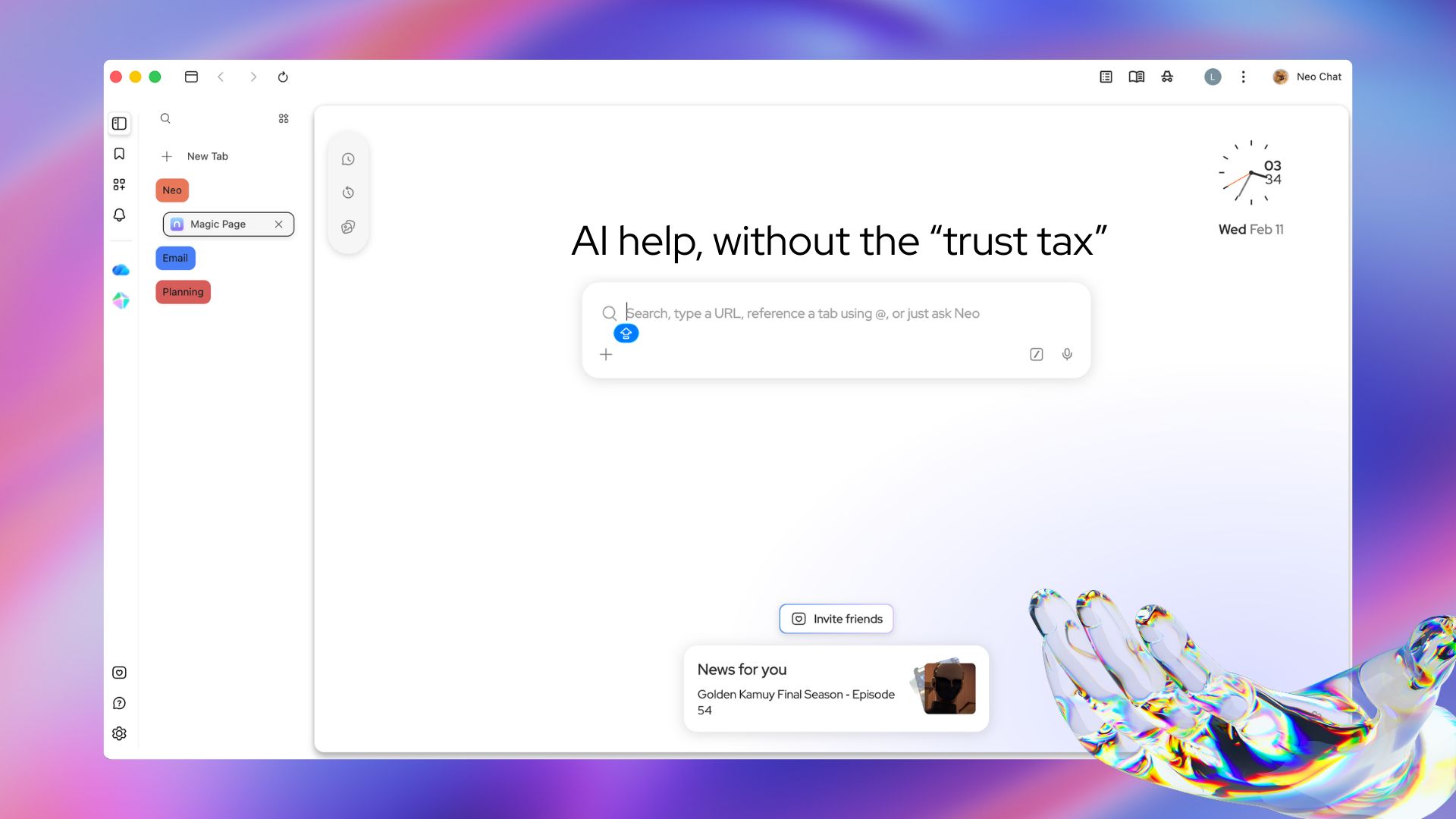
Most AI tools ask you to trade your data for intelligence. Norton Neo doesn't. It's the first safe AI-native browser built by Norton, and it gives you powerful built-in AI without handing your privacy over to get it. Search, summarize, and write with AI built directly into your browser. Your data stays yours. Your context stays private.
Built-in VPN, anti-fingerprinting, and ad blocking come standard. No add-ons. No setup. No compromises.
Fast. Safe. Intelligent. That's Neo.
Today:
OpenAI Automates Cyber Defense
Google Launches AI Agent API
NVIDIA Gives AI Biology Tools
Anthropic Turns Claude into a Teammate
Mistral Upgrades Document Scanning

Frontier AI models have made discovering software vulnerabilities incredibly fast, but human defenders are overwhelmed trying to patch them. OpenAI's expanded Daybreak initiative aims to close this gap by automating the end-to-end remediation process.
GPT-5.5-Cyber: OpenAI launched the full version of this specialized model for trusted defenders. It scores 85.6% on the CyberGym benchmark (the highest single-model score tested) and significantly outperforms standard GPT-5.5 in generating functional exploits and navigating complex codebases.
Codex Security Plugin: Designed to act as a virtual security engineer, this plugin integrates directly into Codex. It scans codebases, validates vulnerabilities by gathering evidence, and generates specific patches for developers to review.
Patch the Planet & Ecosystem Partnerships: In collaboration with Trail of Bits and HackerOne, OpenAI is deploying researchers and AI tools to help maintainers secure over 30 critical open-source projects, including cURL, Python, and Go. Additionally, a new Partner Program allows security vendors to integrate GPT-5.5 into their own defense products.

Google has officially made the Interactions API its primary interface for Gemini models and agents, signaling a transition away from the legacy generateContent API. The GA release is built from the ground up to support stateful, long-running agentic applications.
Managed Agents & Sandboxing: A single API call can now provision a remote Linux sandbox where agents (like the default "Antigravity" coding agent) can reason, execute code, browse the web, and manage files.
Asynchronous Execution & Upgraded Tools: Developers can set tasks to run asynchronously in the background. The API also allows mixing built-in tools (like Google Search and Maps) with custom functions in a single request, and tool results can now include images.
Media & Deep Research: The update integrates advanced media generation, including images via Nano Banana 2 and music via Lyria 3. It also features Deep Research upgrades for collaborative planning and multimodal grounding.
Cost Optimization: A simplified schema replaces "Roles" with "Steps." Google also introduced new routing tiers, including a Flex tier that cuts costs by 50% for latency-tolerant workloads.

General-purpose agents cannot simply be pointed at biology to discover drugs — they need reliable, specialized tools. The NVIDIA BioNeMo Agent Toolkit bridges this gap by packaging core biomolecular capabilities into accessible services.
Agent-Ready BioNeMo Skills: The toolkit provides structured interfaces for AI to use core life science models (like OpenFold3 for protein folding, GenMol for molecule generation, or DiffDock for molecular docking). These "Skills" instruct the agent on the model's exact purpose, required inputs, and how to interpret complex biological outputs.
Flexible Deployment: Agents can call these tools via hosted endpoints for quick testing, or through local NVIDIA NIM deployments when highly iterative research loops require lower latency.
Massive Efficiency Gains: According to NVIDIA's benchmarks, equipping an agent with BioNeMo Skills increased its task completion rate from 57.1% to a perfect 100%, and doubled token efficiency by dramatically reducing setup errors and invalid requests.
🧠RESEARCH
DataClaw0 turns long, messy streams of video, text, and actions into focused material for training AI. The system finds useful evidence, removes repetition, and organizes results into requested formats. Tests showed its task-specific versions rivaled major closed models, while smaller tailored datasets improved video generation, visual questions, and software navigation.
PerceptionDLM describes several areas of an image at the same time instead of processing them one by one. It uses diffusion, a method that repeatedly turns masked text into finished captions. The model reached 62.4% accuracy and produced captions up to 3.5 times faster while remaining competitive with sequential systems.
PlanBench-XL: Evaluating Long-Horizon Planning of LLM Tool-Use Agents in Large-Scale Tool Ecosystems
PlanBench-XL tests whether AI agents can finish long retail tasks using 1,665 partly visible and sometimes faulty tools. Across 327 cases, even leading models struggled to recover when useful tools failed or gave misleading results. GPT-5.4 dropped from 51.90% accuracy without disruptions to 11.36% under the most severe tested condition.
📲SOCIAL MEDIA
🗞️MORE NEWS
Anthropic Introduces "Claude Tag" Anthropic launched a feature that lets teams invite the Claude AI into their group chats as if it were a human coworker. Users can hand off tasks for the AI to complete in the background while they focus on other work. The AI also remembers past conversations so people do not have to constantly repeat themselves.
Mistral Releases Document Reader Mistral released a new tool that reads and organizes text, charts, and images from scanned documents in 170 languages. Instead of just copying the words, it points out exactly where everything is located on the page. This helps businesses securely turn large stacks of messy paperwork into neat, usable information.
Micron and Anthropic Team Up Computer memory maker Micron has partnered with the AI company Anthropic to build better physical parts for advanced computer programs. They are working together to make these highly demanding systems run faster and use less power. As part of the deal, Micron also invested money directly into Anthropic's business.
xAI Adds Independent Task Feature xAI launched a new feature called "/goal" that allows its tool to handle long, complex computer tasks on its own. A user simply gives the program a single target, and it automatically breaks the job into a checklist and finishes the work without needing constant human guidance.
Google DeepMind Partners With A24 Google DeepMind and the movie studio A24 have partnered to create new AI tools specifically for filmmakers. The two companies will work side-by-side so that movie artists can help design technology that actually supports their creative process rather than working against it.
NVIDIA Announces Robot Safety System NVIDIA announced a new safety system called "Halos" for machines that move around in the real world. It provides built-in safety rules and computer chips so that robots can safely work right next to humans in busy places like factories and warehouses.
What'd you think of today's edition? |
Reply