- NATURAL 20
- Posts
- Brussels Probes How Gemini Feeds on the Open Web
Brussels Probes How Gemini Feeds on the Open Web
PLUS: OpenAI and Anthropic Team Up on "Agent" Rules, Anthropic’s Massive Accenture Deal and more.

Wes Roth
December 10, 2025
In partnership with


Shoppers are adding to cart for the holidays

Over the next year, Roku predicts that 100% of the streaming audience will see ads. For growth marketers in 2026, CTV will remain an important “safe space” as AI creates widespread disruption in the search and social channels. Plus, easier access to self-serve CTV ad buying tools and targeting options will lead to a surge in locally-targeted streaming campaigns.
Read our guide to find out why growth marketers should make sure CTV is part of their 2026 media mix.
Hey friend, big day in AI again.
Today’s theme: power plays. Regulators are squeezing Google, Microsoft is betting huge on India, and Mistral is quietly shipping one of the most interesting open coding stacks we’ve seen yet.
Let’s start with the spicy one. 👇
Today:
Brussels Probes How Gemini Feeds on the Open Web
Microsoft’s $17.5 Billion Bet on India
Mistral’s New Tool Wants to Write Your Code
OpenAI and Anthropic Team Up on "Agent" Rules
Anthropic’s Massive Accenture Deal
The EU has opened a formal antitrust investigation into Google over how it uses online content and YouTube videos to build and run its AI features, especially “AI Overviews” in Search and new “AI Mode” tools. Regulators are asking whether Google is giving itself privileged access to publishers’ and creators’ material, on terms they can’t realistically refuse, while rival AI developers don’t get the same deal.
The probe focuses on whether these AI summaries and experiences lean heavily on third-party content without fair compensation or a real opt-out, and whether Google is abusing its dominance in search to supercharge its own AI products. Officials are also looking closely at training on YouTube videos under similar conditions. If Brussels decides Google crossed the line, it could face fines of up to 10% of its global annual revenue—that’s tens of billions of dollars.
Why this matters to us: this is basically the EU putting a price tag and a rulebook on “free” web data. If they come down hard, every major AI lab that leans on scraped content may need new licensing deals or new technical controls. Long term, it nudges the ecosystem toward “data deals” and away from pure “grab whatever is crawlable.”
Satya Nadella just announced Microsoft’s largest investment ever in Asia: a US$17.5 billion commitment to India over four years (2026–2029) to “drive AI diffusion at population scale.” This builds on a previous US$3B pledge from January 2025. The money goes into three big buckets: massive cloud + AI data centers, “sovereign-ready” cloud solutions so data can stay in-country, and a huge skills push.
On the ground, that means expanding India’s hyperscale regions (including a huge new Hyderabad region coming online mid-2026), integrating AI into national labor platforms like e-Shram and National Career Service to support 310M+ informal workers, and doubling Microsoft’s goal to equip 20 million Indians with AI skills by 2030. These platforms will use AI for things like multilingual job search, resume help, and better matching between workers and opportunities.
Zooming out: this is a bet that India becomes one of the world’s main “AI production zones” — not just as a user base, but as infrastructure, talent, and sovereign cloud. If you’re thinking about where AI startups, outsourcing, and enterprise deployments go next, this kind of investment is a giant blinking arrow.
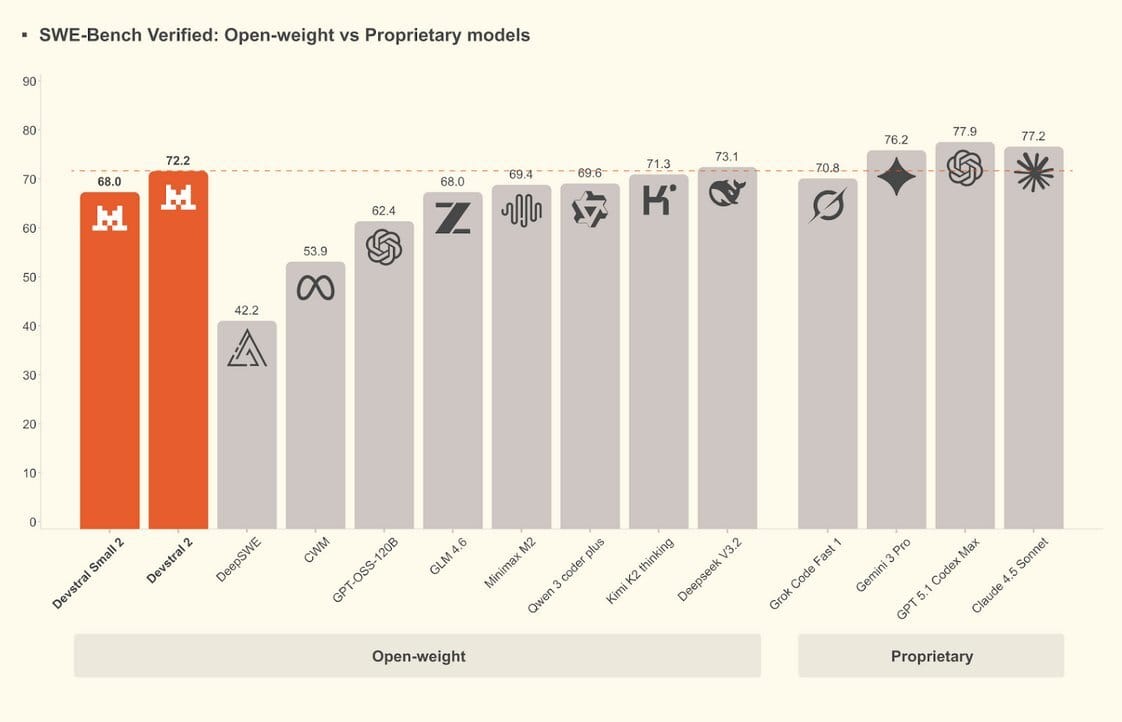
On the tooling side, Mistral announced Devstral 2, a new coding-focused model family, plus Mistral Vibe CLI, a terminal-native agent that actually lives where developers work. Devstral 2 comes in two sizes: a 123B-parameter dense model and a 24B “Devstral Small 2”, both with a 256K context window, and both released as open weights under permissive licenses (modified MIT for the big one, Apache 2.0 for the small one).
On benchmarks, Devstral 2 hits 72.2% on SWE-bench Verified—a tough coding benchmark based on real GitHub issues—and Mistral claims it’s up to 7x more cost-efficient than Claude Sonnet on real-world tasks, while still trailing top closed models in overall quality. Devstral Small 2 reaches 68.0% on the same benchmark and is designed to run locally on consumer-grade GPUs or even CPU-only setups, which is a big deal for indie devs and smaller teams.
Vibe CLI is the fun part: it scans your repo, understands your file tree and Git status, lets you reference files with @, run shell commands with !, and orchestrate multi-file changes from the terminal or via IDEs like Zed using the Agent Communication Protocol. Mistral is clearly aiming at “agentic dev tooling” that feels native, not like a chat window glued onto your editor. Early partners like Kilo Code and Cline are already integrating it, and Devstral 2 is free via API for now, with post-free pricing set at $0.40 / $2.00 per million input/output tokens.
If you’re building with AI agents today, this is another serious open-source option that can actually live in your workflow instead of just being a demo.
🧠RESEARCH
This research teaches AI to "think" about multiple solutions at the same time, rather than going step-by-step. By training the system to explore different possibilities simultaneously, it solves complex problems much faster. The new method speeds up processing by over four times while effectively improving accuracy on difficult tasks.
Creating detailed AI images usually takes many slow steps. This paper introduces a method that lets computers build high-quality images in a single attempt. By teaching the model to correct its own mistakes during training, it matches the quality of slower systems but works instantly, saving massive amounts of computing power.
When teams of AI bots fail a task, finding the error is difficult. This new tool doesn't just read error logs; it actively tests fixes by changing the bots' instructions to see what works. This hands-on approach automatically repairs broken tasks nearly half the time, making complex AI systems more reliable.
🛠️TOP TOOLS
Each listing includes a hands-on tutorial so you can get started right away, whether you’re a beginner or a pro.
Arcwise AI – AI-Powered Spreadsheet Analysis - AI data analyst that runs inside Google Sheets.
Arduino Code Generator – Arduino Project Development - turns plain‑English instructions into working Arduino sketches
Argil AI – Generate Videos With Your AI Clone - lets you “clone” yourself and turn scripts into short, social‑ready videos in minutes
📲SOCIAL MEDIA
🗞️MORE NEWS
OpenAI, Anthropic, and Block Team Up Three major tech rivals are joining forces to create a common set of rules for AI "agents," which are digital assistants that can perform tasks on their own. They launched a new non-profit group to ensure that AI tools from different companies can talk to each other without glitches. This move is designed to prevent any single corporation from controlling the future of AI while keeping American technology ahead of foreign competitors.
OpenAI’s "Code Red" OpenAI CEO Sam Altman has declared an emergency "code red" to fix ChatGPT as competition from Google heats up. The company is reportedly pausing other big projects to focus entirely on making their chatbot faster, smarter, and easier to use. This drastic step is a direct response to Google’s new models, which have started beating OpenAI in key performance tests.
Anthropic and Accenture Partnership Anthropic has signed a massive deal with consulting giant Accenture to get its AI, named Claude, into the hands of more big businesses. Accenture plans to train 30,000 of its own employees to become experts in Claude so they can help other companies install and use the technology. The goal is to help businesses stop just experimenting with AI and start using it safely for real daily work.
Meta’s "Avocado" Strategy Shift Meta is reportedly changing its plans to build a closed, secret AI model codenamed "Avocado," moving away from its famous strategy of giving away technology for free. This pivot has caused confusion and stress inside the company, with reports of grueling work hours and sudden project cancellations. It suggests that Mark Zuckerberg wants to create a paid product to compete directly with Google and OpenAI, rather than just being the open alternative.
OpenAI Investigates AI Jobs OpenAI is hiring a new team of economists to study exactly how artificial intelligence will change the job market and the global economy. Instead of just guessing, they want to gather real data to figure out which careers are at risk and how to help workers adapt to the changes. This effort is part of their promise to prove that powerful AI can help people rather than just replacing them.
Z-AI’s New Vision Model A new free-to-use AI model called GLM-4-6v has launched with the unique ability to "see" computer screens and understand how to use them. Unlike older models that only read text, this one can look at a picture of software and instantly know which buttons to click to finish a task. This makes it much easier for developers to build computer programs that can navigate websites and apps just like a human does.
AI and the Human Brain New research reveals that the human brain processes language in a continually similar way to modern AI systems like ChatGPT. Scientists found that our brains break down speech in layers, starting with simple sounds and moving to complex meaning, exactly how these computer models do. This discovery challenges old theories about how we think and suggests AI might be a better map of the human mind than we previously believed.
What'd you think of today's edition? |
Reply